Who hasn’t let their hand drift across a blank sheet of paper and absentmindedly draw or write the most bizarre things: little circles, houses, flowers, smileys, seemingly meaningless words? While on the phone, during a meeting, during an interview: every moment offers the opportunity to reveal yourself. Because what seems like a scribble, a word thrown there, reveals a part of us. And inpsychotherapy these revelations, as it can be aDrawings, have a significant impact. They are what we commonly call doodles, or drawings that appear meaningless, but which to the therapist can reveal to be rich in meaning.
TheDrawing is part of the unconscious, like dreams, and can be more real than words because it reveals unexpressed feelings. These are manifestations in which we remove the mask from our most authentic emotions and reveal something about ourselves, ironically and without hypocrisy.
The theory of attributing, in psychotherapy, a projective meaning to the drawing It starts from the observation made by Goodenough according to which, in addition to being able to derive a mental age quotient, personality traits can also be glimpsed from drawings. Buck (1948) and Machover (1949) in particular pursued this hypothesis.
It should not be forgotten, first of all, that we are talking about a therapeutic-psychological tool, and that, as with the difference between a friendly support interview and a professional one, in the same way, inside the psychotherapy, the use of the drawing It’s a methodology that can’t be improvised.
Particular tests that are based on drawing and used with a certain frequency in therapy (also and above all with children), are, for example, that of human figure and that of the family.
“The basic theoretical assumption is that the drawing of the human figure represents the expression of the self, or of the body, in the environment, and the composite image that constitutes the drawn figure is intimately linked to the Self in all its ramifications” (Machover, 1949).
Working with drawing, therefore, means knowing a specific technique based on the psychological meanings of graphic gestures, on the reading of colors and on a deep understanding of conscious and unconscious contents.
Drawing as a therapeutic tool It is often a custom and is part of specific therapeutic practices. The therapist’s approach will certainly be a consequence of the therapeutic approach one wishes to establish with a specific patient.
The drawing It is nothing more than a set of figurative or abstract graphic gestures. It is essentially a gesture that occurs spontaneously from early childhood, and it is an important gesture precisely because it transforms the subject’s thoughts and sensations into images. Just as a word expresses and declares a sensation: that is, from the moment I express it, I make it real, I communicate it, I attribute meaning to it and I take greater note of it; Drawing is expressed in the same way. The difference lies in the fact that, precisely as a consequence of its characteristic figurative nature, being aimage it becomes an awareness that is often greater or more immediate.


Draw, doodling or writing on a blank sheet of paper are part of the so-called unconscious language, and can be more real than words because they reveal unexpressed feelings, especially in the context of psychotherapy.
And drawing It is one of those events in which we take off the mask of our most authentic emotions and tell, in an ironic and hypocritical way, something about ourselves..
Writing, doodling on a piece of paper during a meeting, whether work-related or otherwise, has therefore happened to many, if not all.
Each individual goes through different stages in their approach to graphic expression: both in everyday life and in therapy. Furthermore, beyond what are identified as acquisition phases, there are also different conceptual frameworks (strands) within which psychological studies of drawing move..
There are so-called projective tests, such as the human figure, house, and tree tests, which use the stimulus of drawing to spontaneously externalize the person’s internal psychological contents. For these reasons, during the psychotherapy, The drawing It becomes a tool that uses precise rules, is based on specific psychological theories, and is tailored to the specific characteristics of the subject and the topics they bring to the session. In short, it is not improvisation.
Today it is possible to have the possibility of doing this type of activity online, even during a meeting. online psychotherapy.
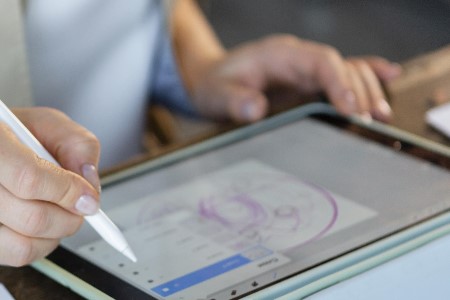
In PsyCare it is possible to draw (and upload other images) on a blank sheet integrated and connected directly to the seat online psychotherapy: it is the so-called virtual blackboard. And it is possible to save the work directly within PsyCare: the therapist will always have it available and the patient will be able to resume, if the therapist allows it, the work of the previous session for complete it independently. In this case, technology remains at the service of the individual’s needs and becomes innovation.
Scholars are convinced that drawing and doodling is healthy because it involves mental and physical processes that keep the mind active, alert, and focused; thus, thoughts are prevented from wandering. Its natural nature should not be underestimated.relaxingwhich allows you to release tension: on a sheet of paper, on a blank page, you leave the negative sensations and moods of the moment.
The drawing as a therapeutic tool It therefore creates a well-structured dimension full of meanings: some more obvious, some more latent.
Different, as is right, depending on the approach; but this, in turn, can also affect the type of meanings that can be captured in the graphic features. However, simply observing a drawing or a scribble can be an extremely useful tool in the therapeutic assessment of many patients. And therapists know this well.
The patient sees himself in the video consultation: when it is necessary
The digital signature in PsyCare? Just a click away!
Sharing a document online: it’s easy on PsyCare
PsyCare’s online calendar reminds you of appointments with a reminder!
Personalizing your online session invitation: why it’s important
Patient ID: Is it mandatory?
Online group therapy? You can do it on PsyCare!
Drawing, shapes, and images in psychotherapy: online with the virtual whiteboardWhatsApp: +39 375 703 9065
General Inquiries: info@psycare.it
Support: help@psycare.it

PsyCare for the Environment
We offset CO₂ emissions by planting a tree for every activated subscription: learn more.