- Email:info@psycare.it
- WhatsApp: +39 375 703 9065

PsyCare integrates the digital signature for signing informed consent and other important documents online. The digital signature is the electronic equivalent of a handwritten signature, which is the signature normally placed on documents with pen and paper, because like the latter it guarantees the authenticity and integrity of the document/message.
It therefore meets the following requirements:
– integrity, or certainty that the document has not been tampered with or modified after signing;
– authenticity, therefore guarantee of the identity of the person signing;
– I do not repudiate, since the signed electronic document has full legal validity and cannot be repudiated by the signatory.
The practice of a healthcare profession, as important and delicate as that of a psychologist, presupposes the management of all of a patient’s sensitive data..
Informed consent, privacy policy, contract, authorizations, releases, etc., are the wall against which a professional will inevitably have to come up against to get important documents signed. The solutions normally adopted for signing the informed consent are essentially two: wait to see the patient in the office and risk also contravening the stringent and costly regulations or have the document signed by exchanging emails and scanned documents, the latter solution having no legal value.
How to do it? Have the informed consent form signed online with PsyCare!
PsyCare makes available to psychologists and psychotherapists (for the digital signature of documents, such as the online informed consent and other important documents) Advanced Electronic Signature (FEA) and thus allows professionals to practice their healthcare profession in full compliance with the law, in a simple manner and in full compliance with ethics and the law.
Documents signed with PsyCare are certified by the European Union (eIDAS regulation).
SPID is NOT required for the Digital Signature in PsyCare.
In PsyCare, signing the informed consent is simple and safe.
The most suitable way to subscribe to the general conditions of the contract, rather than the privacy policy, or to sign an online informed consent is to use an Advanced Electronic Signature (FEA) based on “One Time Password” technology (OTP Signature or FEA OTP), which allows you to sign a contract with a simple SMS!
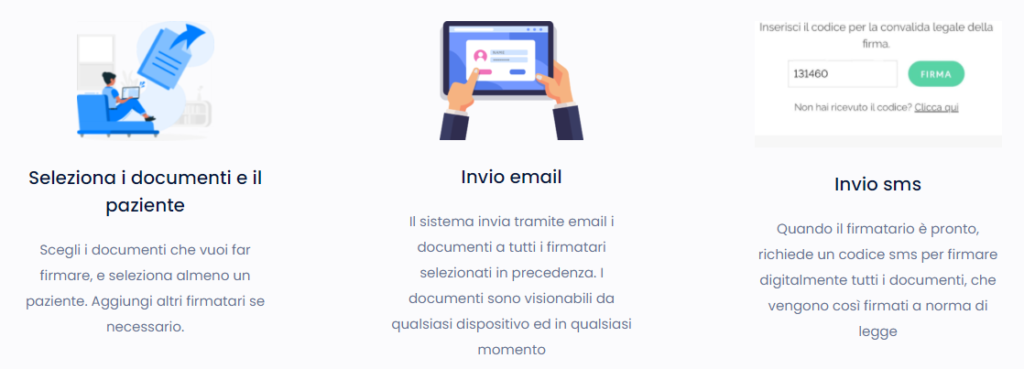
You choose the documents you want to have signed, and select at least one patient.
Add additional signatories if needed.The system forward via email the documents to all previously selected signatories.
Documents can be viewed from any device, at any time.When the signatory is ready, he requests an SMS code to affix the business digital on documents.
The documents are thus signed in accordance with the law.
The Advanced Electronic Signature based on “One Time Password” technology(FEA-OPT), so:
- allows you to sign a contract online by sending a simple SMS via a normal mobile phone;
- it is an electronic signature connected solely to the signatory;
- is subject to compliance with a series of requirements, set out in Article 26 of the same eIDAS Regulation
- compared to the qualified electronic signature, it is much simpler, faster and more effective;
- does not require the purchase of expensive digital certificates or sophisticated digital signature tools.
Pursuant to art. 20 of the LEGISLATIVE DECREE 7 March 2005, n.82:
“An online contract signed with an Advanced Electronic Signature (FEA OTP) via SMS satisfies the written form requirement and provides full proof, until a complaint of forgery is filed, of the origin of the signatory’s statements.
A digital signature obtained with a service managed by a Certification Authority (CA), authorized to send electronic signatures through the electronic signature certificates it holds (such as the one referred to by PsyCare), will be recognized at national and European level.
The Certification Authority (CA) to which PsyCare is connected protects users because:
– is recognized by the European Union Commission as a trusted provider of electronic signature services;
– data is encrypted and hosted on secure EU servers;
– has electronic signature certificates.
Electronic signature, digital signature: what are we talking about?
Article 3 of REGULATION (EU) No 910/2014 OF THE EUROPEAN PARLIAMENT AND OF THE COUNCIL on electronic identification and trust services for electronic transactions in the internal market defines:
electronic signature, data in electronic form, enclosed or logically associated with other electronic data and used by the signatory to sign;
advanced electronic signature, an electronic signature that meets the requirements set out in Article 26;
qualified electronic signature, an advanced electronic signature created by a qualified electronic signature creation device and based on a qualified certificate for electronic signatures.
Simple Electronic Signature
An electronic signature consists of a set of data in electronic form, “attached to or logically associated with other electronic data and used by the signatory to sign” (Article 3, point 1, no. 10, eIDAS Regulation). This definition refers to the so-called simple or weak electronic signature. More generally, a simple electronic signature can be defined as any data connection useful for the electronic authentication of an electronic document. In itself, it represents a tool that does not offer many security guarantees, since does not meet the required requirements for stronger electronic signatures. In fact, the simple electronic signature fails to ensure the three fundamental objectives pursued by other types of electronic signatures: authenticity, non-repudiation, and document integrity. For example, a PIN code or website login credentials fall within the scope of a simple electronic signature.
Advanced Electronic Signature
The advanced electronic signature (FEA) Pursuant to Article 3, point 1, no. 11 of the eIDAS Regulation, an electronic signature is subject to a series of requirements, set forth in Article 26 of the same Regulation. Specifically, the FEA is an electronic signature uniquely linked to the signatory, and must be capable of identifying him or her. In this case, the means required to create it can be used securely by the signatory under his or her exclusive control, and the signed data is linked to the FEA, allowing for any subsequent changes to be identified. Compared to the simple electronic signature, it offers some additional security features.
Qualified Electronic Signature
The qualified electronic signature (QES) is a specific type of advanced signature (Article 3, point 1, no. 12, eIDAS Regulation) and uniquely guarantees the identity of the holder; in terms of legal effectiveness, it is equivalent to a handwritten signature, as established by Article 25 of the eIDAS Regulation. However, a qualified electronic signature, in addition to being based on a qualified certificate, must be created using a qualified signature device. These devices consist of removable electronic media (smart cards, USB sticks, tokens) that allow their holder to sign an electronic document by adding their qualified electronic signature.
The legislation on digital signature
We recall that European regulations on electronic signatures are the strictest.
Third-party providers must comply with specific regulations and obtain an electronic signature certificate to offer their services. Certified providers are subject to frequent audits by independent experts selected by the European Commission.
The reference legislation, therefore, is the European Regulation on electronic identification and trust services for electronic transactions in the internal market (abbreviated to eIDAS, acronym for electronic IDentification, Authentication and trust Services, officially Regulation (EU) No. 910/2014), is a European Union regulation, which concerns electronic identification and trust services for electronic transactions in the European Common Market (ECM).
The regulation replaces the previous Directive 1999/93/EC.
The FEA (Advanced Electronic Signature) meets all the requirements set out in Article 26 of the eIDAS Regulation and Article 56 of the Prime Ministerial Decree of February 22, 2013. Among the most important requirements are the document’s unalterability after signing, the signature’s traceability to a specific person, and the exclusive use of the signature tools.
In the Digital Administration Code (CAD) from art. 1, paragraph 1, letter q-bis) of Legislative Decree 7 March 2005, n. 82, the Advanced Electronic Signature (AES) is defined as:
the set of data in electronic form attached to or connected to an electronic document that permits the identification of the signatory of the document and guarantees a unique connection to the signatory, created using means over which the signatory can maintain exclusive control, linked to the data to which the signature refers in such a way as to permit detection of whether the data itself has been subsequently modified.
It is not a “simple” electronic signature, but a specific type based on a specific key mechanism. Simply put, an electronic signature is a type of signature that satisfies particularly stringent requirements, guaranteeing the authenticity, integrity, reliability, and legal validity of documents. It has the same value as a handwritten signature (a characteristic not shared by other types of electronic signatures).
It constitutes a stronger signature than the simple electronic signature, as defined in art. 1, paragraph 1, letter q of the Digital Administration Code, because:
allows the identification of the signatory and the unique connection of the same to the signed document;
such connection is created using means over which the signatory can retain exclusive control;
It allows you to detect whether the data has been modified after the advanced electronic signature was applied.
Regarding the Digital Administration Code (CAD), art. 21, paragraph 2, of the provides that:
An electronic document signed with an advanced, qualified, or digital signature, created in compliance with the technical rules referred to in Article 20, paragraph 3, which guarantee the identifiability of the author, the integrity, and the unalterability of the document, has the effectiveness established by Article 2702 of the Civil Code. Use of the signature device is presumed to be attributable to the holder, unless the holder proves otherwise.
The legal effects of the advanced electronic signature
The legal effects of an electronic signature depend on their ability to satisfy the written form requirement, their legal effectiveness, and the burden of proof. The latter refers to the identification of the party who, in the event of a dispute, must provide evidence demonstrating the validity or invalidity of the contested signature.
Documents signed with an advanced electronic signature meet the written form requirement and have the effectiveness provided for by Article 2702 of the Italian Civil Code. The party to whom the advanced electronic signature belongs may disown it; the burden of proof for the party wishing to avail itself of the legal effects of such a signature is on the party wishing to avail itself of the legal effects of such a signature to demonstrate compliance with the provisions of Title V of the aforementioned Prime Ministerial Decree. The advanced electronic signature may be used only for legal relationships between the signatory and the entity providing the advanced electronic signature solution, for the purpose of using it in relationships with third parties for institutional, corporate, or commercial purposes.
The eIDAS standards were implemented across the European Union in July 2016. The set of regulations specified by eIDAS enshrines in law the recognition and legal requirements of electronic signatures within the European Union.
The Certification Authority (CA) operating for PsyCare holds eIDAS compliance certificates for electronic signature, electronic seal, and qualified time stamp services.
The digitalization of processes, therefore, requires the signing of the contract online with electronic signature solutions. It is therefore essential to rely on those who guarantee certified solutions that fully comply with current legislation.

PsyCare for the Environment