PsyCare and the detection of emotions

Why not take advantage of some extra help when there is one? PsyCare to provide it?

Find out in detail how to use PsyCare’s primary emotion detection to your advantage.

PsyCare and the detection of emotions

Why not take advantage of some extra help when there is one? PsyCare to provide it?

Find out in detail how to use PsyCare’s primary emotion detection to your advantage.

Everything you can do with emotion detection

The characteristics of emotion detection

PsyCare introduces the innovative feature of primary emotion detection.

Artificial Intelligence to support the therapist
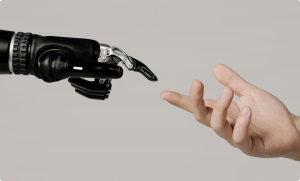
IA IN SUPPORTO ALLA PSICOLOGIA

Credit by Freepik

Artificial intelligence has the potential to improve various aspects of clinical psychology and psychotherapy, from diagnosis to treatment planning and the therapeutic relationship itself (Vilaza & McCashin, 2021) (D’Alfonso, 2020) (Yang et al., 2020) (Aktan et al., 2022).

The effectiveness of the application of AI to psychotherapy has been widely demonstrated by the continuous scientific studies published. AND PsyCare he receives it.

Nonetheless, addressing challenges related to data privacy, cognitive biases, and the role of humanity in psychological practice remains paramount.

The evolution of the sector is continuous, and the impact on psychology will inevitably proceed in parallel: important new opportunities for mental health support are underway.

Real-time monitoring

The ability to manage and define this type of setting in PsyCare from the first video consultation it is extremely relevant for therapeutic and relational purposes. 

It also defines the approach that the professional intends to give to the therapeutic path that the patient will have to follow.

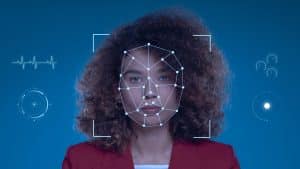
The algorithm referred to for facial recognition is a type of computer vision that uses thereal-time optical input to analyze an image, with very high accuracy values.

Safety first

In the EU, the use of artificial intelligence is regulated by the first Dedicated World Regulation, that guides the safe and ethical application of AI.

The priority was to ensure that artificial intelligence systems used in the EU are safe, transparent, traceable and non-discriminatory.. The Artificial Intelligence Regulation is now fully applicable.

In PsyCare all data and information exchanged are managed in full compliance with industry regulations (on encrypted and secure servers) and are not and will never be shareable or accessible to anyone other than the therapist. Furthermore, they do not constitute input data for the reference algorithm which, consequently, is not fed by the aforementioned data.

How the algorithm works

Machine Learning algorithms use parameters based on training data, or a subset of data that represents the larger set and follows, in a nutshell, the following steps:

• Image acquisition
• Face detection
• Feature Extraction
• Database comparison
• Identification and verification.
RICONOSCIMENTO FACCAILE DONNA

Credit by Freepik

The integrated Artificial Intelligence algorithm in PsyCare It detects, at two-second intervals, the optical inputs of the patient’s face and searches for a match with the known expressions in its database.. 

This results in an immediate temporal historicization of the findings made; findings which will then be made available to the therapist for his medical evaluations.. 

Primary emotions

Post-it Emozioni

Credit by Freepik

The six basic expressions are evident across cultures: disgust, fear, joy, surprise, sadness, and anger. They are universal in their execution and perception (Ekman & Keltner, 1997).

Emotion recognition aims to detect the emotional state of humans and in PsyCare focuses mainly on the detecting emotions from the face which maps the movements of 43 facial muscles, associating their combination with the corresponding primary emotions.

Detecting facial expressions relies on understanding the movements of 43 facial muscles.

In the medical field, therefore also and above all for Mental Health, Emotion AI technologies can help monitor the emotional state of patients and provide personalized support in therapies, identifying signs of anxiety, depression or stress in a timely manner.. 

In psychotherapy, more specifically, primary emotions play an important role: cThey help to overcome secondary emotions, tojute to understand the underlying needs, pthey disrupt the transformation, because toincrease awareness and activate the patient on action paths more responsible personnel.

Primary emotions, despite their intensity, have an evolutionary and protective function. In psychotherapy, we often explore how these emotions can be rebalanced to promote psychological well-being. It’s not just about labeling or analyzing primary emotions, but also about develop skills to evaluate them, manage them and respond to them in a healthy and conscious way.

This feature is not available for group sessions and initial consultations.

Mental Health: The Usefulness of PsyCare’s Emotional Detection

Four good reasons why PsyCare's emotion detection can help you in your profession

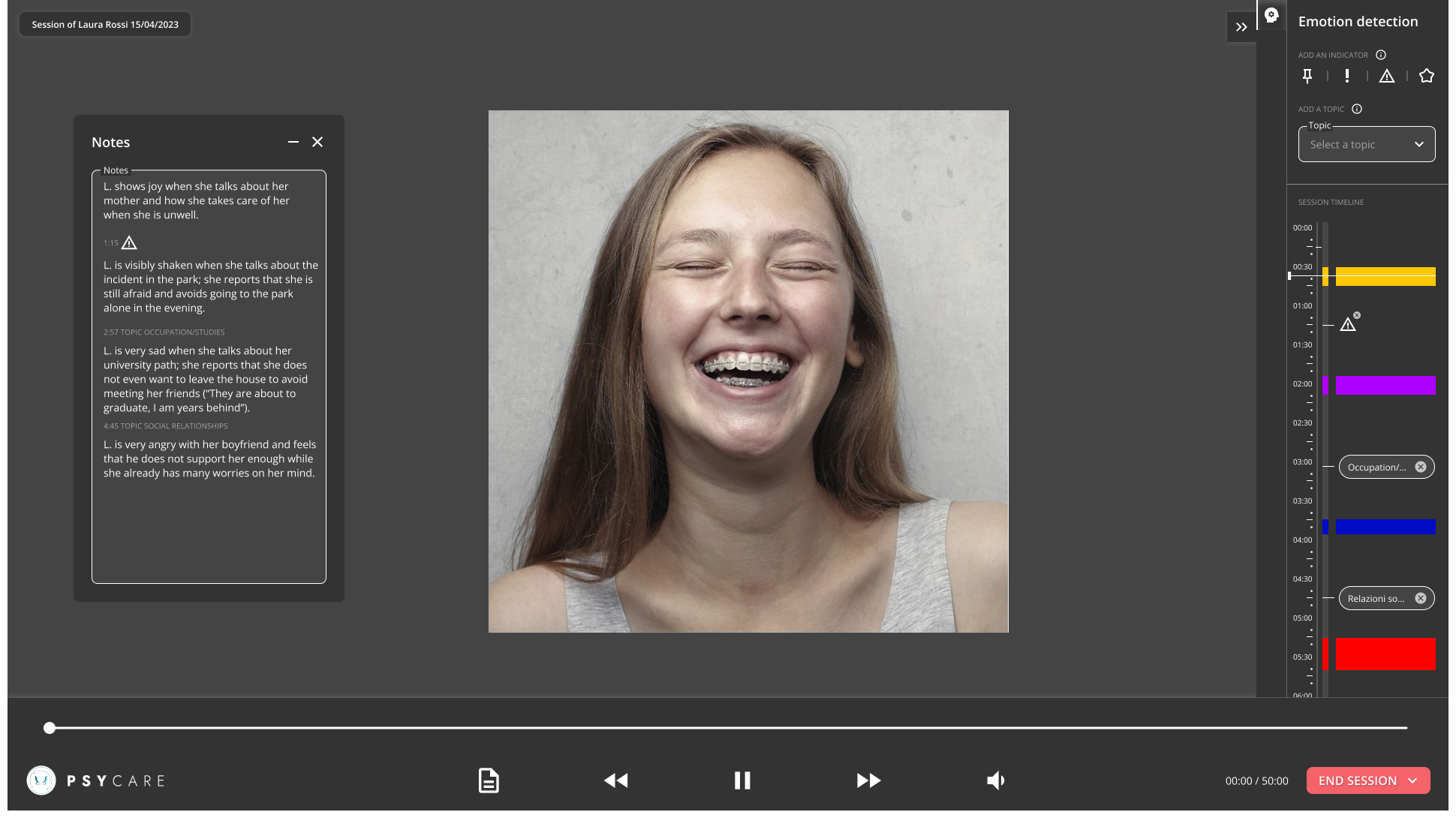
Sedute registrate con PsyCare e uso delle note

◆ Focus on your patient while PsyCare collects data
Automatically saving AI-supported findings allows you to manage your therapeutic activities for each individual patient more seamlessly and without burdening you with additional supplementary activities. You can analyze the data whenever you need.

◆ LI.A. opens the door to new useful features
In therapeutic conversations, AI can help the therapist analyze how a person expresses their emotional self, even through non-verbal language.

◆ Review the recordings paying attention to the detection of emotions
In the recording you see the findings made previously and you have time to analyze and reevaluate them, possibly also with your patients.

◆ View the graphs relating to the detected emotions
Three types of graphs that help you evaluate the progress of therapy: themes and emotions, emotions in the last session, and emotions in a time frame of your choice. The patient has no evidence of anything and maintains spontaneity throughout the therapeutic session.. 

Mental Health: lusefulness of PsyCare emotion detection

Four good reasons why PsyCare's emotion detection can help you in your profession

◆ Focus on your patient while PsyCare collects data
Automatically saving AI-supported findings allows you to manage your therapeutic activities for each individual patient more seamlessly and without burdening you with additional supplementary activities. You can analyze the data whenever you need.

◆ LI.A. opens the door to new useful features
Graphs Reports Recording with emotion detection

◆ Review the recordings paying attention to the detection of emotions
In the recording you see the findings made previously and you have time to analyze them

◆ View the graphs relating to the detected emotions
Three types of graphs to help you evaluate the progress of therapy, themes and emotions, emotions in the last session, emotions in a time frame of your choice

Discover all the features of PsyCare

Try the Professional Plan for free!

Try the Professional Plan now for free to learn more about how PsyCare’s emotion detection works and all the other benefits this plan offers!
We also recommend requesting a free online demonstration with our staff; they’ll be happy to answer any questions you may have.

Discover all the features of PsyCare

Try the Professional Plan for free!

Try the Professional Plan now for free to learn more about how PsyCare’s emotion detection works and all the other benefits this plan offers!
We also recommend requesting a free online demonstration with our staff; they’ll be happy to answer any questions you may have.